
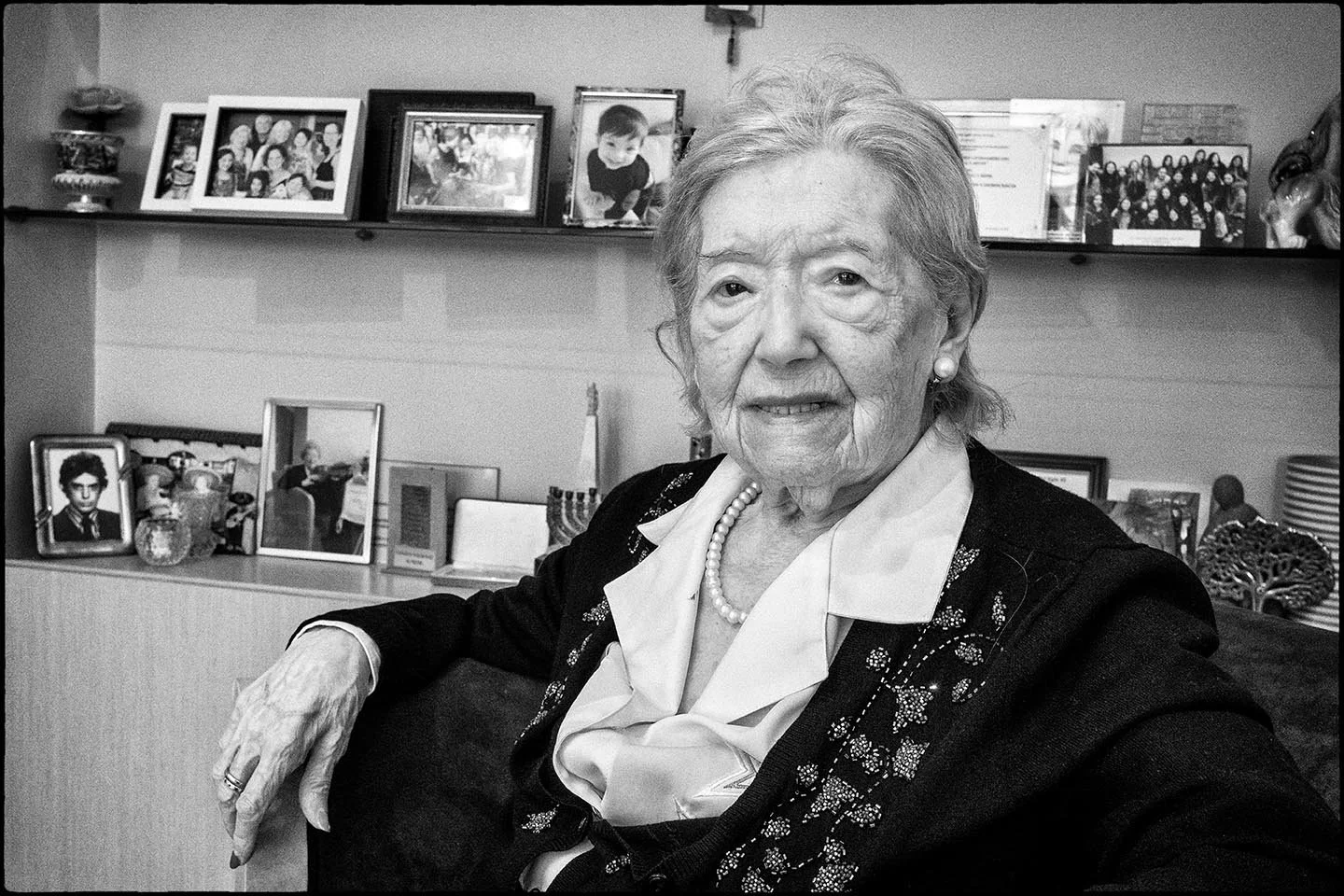
Sara Laskier de Rus / Argentina 2023
Schejene María Laskier de Rus, known as Sara Rus, was born in 1927 in the city of Lodz, Poland. At the age of twelve, she suffered the violence of Nazism when she and her family were forced into the Lodz Ghetto. Later, she endured inhuman living conditions in the Auschwitz concentration and extermination camp, and was eventually taken to Mauthausen, where she was liberated. After the war ended, Sara and her husband Bernardo, both survivors of the concentration camps, emigrated to Argentina with the hope of beginning a new life and building a family.
Sara was able to have two children, overcoming the physical difficulties caused by a body severely damaged by her prolonged imprisonment in the concentration camps. On July 24, 1950, Daniel was born, followed five years later by Natalia.
In 1977, Sara once again became a victim of violence, this time under State terrorism in Argentina: on July 15, her son Daniel was kidnapped from the National Atomic Energy Commission, where he worked as a scientific researcher. From that moment on, Sara began searching for him, undertaking countless efforts at both national and international levels.
Today, Sara is a member of Mothers of Plaza de Mayo – Founding Line and of the Association of Survivors of Nazi Persecution, embodying the dual condition of a survivor of the Nazi genocide and a victim of Argentina’s last civic-military dictatorship.
Testimony:
“In Auschwitz-Birkenau, the men were taken away immediately. I never heard from my father again. I dared to approach an SS officer who was standing in the middle of the square with a riding crop. People were looking at me. I thought they were going to kill me. He looked at me and said: ‘How dare you come near me?’ I said to him in German: ‘Why did you take my mother away from me?’ When I think today about what I did... He looked at me and asked: ‘Where did you learn German?’ I told him that German was spoken in my home. He asked me: ‘Which one is your mother?’ and then said: ‘Go and get her.’ That was the first time we were saved. From then on, my mother was always with me. She survived the war with me. But we went through very hard times.”
“In all the experiences I share with young people, from what my life was like in Poland, to the terrible experience of the war, to the loss of my son, who disappeared in 1977, what I mainly want to leave them is a message of love. I fight so as not to forget. I fight for Memory. So that the Nazis, those from there and those from here, may never again have the power they once had. Memory is the most important thing. If we do not have memory, things happen again.”
_________________________
Schejene María Laskier de Rus, conocida como Sara Rus, nació en 1927 en la ciudad de Lodz, Polonia. A los doce años sufrió la violencia del nazismo siendo trasladada con su familia al gueto de Lodz. Más tarde sufrió condiciones de vida infrahumana en el campo de concentración de Auschwitz y por último fue llevada a Mauthausen, lugar donde fue liberada. Cuando finalizó la guerra, Sara y su esposo Bernardo, sobrevivientes de los campos de concentración, emigran a la Argentina con la ilusión de iniciar una nueva vida y construir una familia.
Sara logró tener dos hijos, superando las dificultades orgánicas consecuencia de un cuerpo deteriorado por su prolongado paso por los campos de concentración. Fue así como el 24 de julio de 1950 nació Daniel y cinco años más tarde, Natalia.
En 1977, una vez más, Sara fue víctima de la violencia del Terrorismo de Estado: el 15 de julio su hijo Daniel fue secuestrado en la Comisión Nacional de Energía Atómica, donde desarrollaba tareas de investigación científica. A partir de ese momento, Sara inicia su búsqueda realizando innumerables gestiones a nivel nacional e internacional.
Hoy, Sara es miembro de Madres de Plaza de Mayo - Línea Fundadora y de la Asociación Sobrevivientes de la Persecución Nazi, encarnando su doble condición de sobreviviente del genocidio nazi y víctima de la última dictadura cívico-militar en Argentina.
Testimonio:
“En Auschwitz-Birkenau a los hombres directamente los sacaron. Nunca más supe de mi padre. Me atreví a acercarme a un SS con un rebenque que estaba en el medio de la plaza. La gente me miraba. Pensaba que me iban a matar. Él me mira y me dice: «Cómo te atreves a acercarte». Le dije en alemán: «¿Por qué me sacaste a mi madre?». Si hoy pienso lo que hice... Me mira y me dice: «¿De dónde hablas alemán?». Le dije que en mi casa se hablaba alemán. Me preguntó: «¿Cuál es tu madre?», y me dijo: «Anda a buscarla». La primera salvada. Desde ese entonces mi madre estuvo siempre conmigo. Sobrevivió a la guerra conmigo. Pero pasamos momentos muy duros”.
“En todas las experiencias que les cuento a los jóvenes, desde cómo fue mi vida en Polonia, la terrible vivencia de la guerra, hasta la pérdida de mi hijo desaparecido en el año 77, lo que principalmente quiero legarles es un mensaje de amor. Yo lucho por no olvidar. Lucho por la Memoria. Para que jamás los nazis, los de allá y los de aquí, tengan la fuerza que han tenido. La memoria es lo más importante. Si no tenemos memoria las cosas vuelven a pasar”.